When Is a Naked Body Suddenly Indecent?
There are stories that make you angry, stories that make you laugh, and then there are stories that leave you wondering whether somewhere along the way we have collectively lost our ability to distinguish between genuine harm and the simple discomfort of someone who happens to disagree with us. A recent incident in Sardinia falls rather neatly into the third category. According to L'Unione Sarda, two couples enjoying a beach at San Vero Milis were each fined €3,333 after being found naked outside the area officially authorised by the municipality for naturism. Four people, more than €13,000 in fines, because they were sitting on a beach without their clothes.
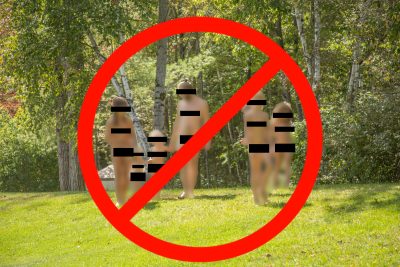
There is, of course, a legal explanation. The naturist area had been designated by the local authority, and the people concerned were outside that designated area. The reported offence was dealt with under Article 726 of the Italian Criminal Code, concerning acts contrary to public decency. The couples reportedly said they had previously used the authorised naturist area but had moved elsewhere, and that after arriving at the new location they had asked other beachgoers whether naturism was tolerated there and had been told that it was. They removed their clothes, settled beneath their umbrellas and enjoyed the beach until plain-clothes officers arrived and the matter took a very different turn.
What is fascinating about this story is not simply the size of the fine, although €3,333 for each person is certainly enough to make anyone sit up and take notice. What interests me far more is the underlying idea of decency and the strange way in which it can apparently be attached to a particular piece of geography. The human body itself has not changed. The people involved have not suddenly become different people because they moved from one part of the beach to another. They have not become more sexual, more threatening, more offensive or more dangerous. They have simply crossed an administrative boundary.
Inside the designated area, their nakedness is acceptable. Outside it, the same nakedness can apparently become an offence against public decency. The beach is still the beach, the sea is still the sea, the sun is still shining and the human body remains exactly what it was a few moments earlier. Nothing about the physical act of being naked has changed. Only the legal interpretation of where that nakedness is taking place has changed.
That distinction is important because it exposes something much larger than a disagreement about beach regulations. It exposes the extent to which we have allowed the concept of decency to become detached from the concept of harm.
I have no difficulty accepting that public spaces need rules. People share beaches, parks, streets and other environments, and those people do not necessarily have the same expectations. Someone may want to spend an afternoon swimming while wearing a swimsuit, while someone else may prefer to swim without one. Someone may be uncomfortable around nudity, while another person may see nothing unusual about it whatsoever. A functioning society has to find ways for people with different preferences to occupy the same world.
But there is a significant difference between saying that people have different preferences and saying that one person's preference should automatically become a restriction upon another person's freedom.
That is where the freedomist argument begins.
I do not believe that everyone should be naked. I have no desire to tell somebody who prefers to wear a swimsuit that they should remove it. Nor do I believe that a person who is uncomfortable with nudity should be ridiculed or forced into an environment where they feel genuinely distressed. Freedom has to work in both directions. My freedom to live according to my choices cannot reasonably mean that everybody else must live according to them as well.
But the reverse should also be true. Someone else's discomfort should not automatically give them ownership over my body.
There is a profound difference between I don't want to be naked and you must not be naked. The first is a personal choice. The second is an exercise of authority over another person's choice. The question for a freedomist is therefore not whether everyone likes nudity. Of course they do not. The question is whether simple, non-sexual nudity causes sufficient harm to justify the state imposing a substantial penalty upon someone who engages in it.
Naturism has always presented a challenge to societies that have become accustomed to treating the naked body as something that must be hidden. Yet there is nothing particularly radical about the human body itself. Every human being possesses one. Every human being was born without clothing. The body existed long before the social conventions that eventually decided which parts should be covered, when they should be covered and what it supposedly means when they are not.
For a naturist, removing clothing does not necessarily carry the meaning that a clothed society has attached to it. There is no sexual act involved simply because somebody is naked. There is no indecency simply because somebody has removed their swimsuit. A person can sit on a beach, read a book, swim in the sea, walk along the shoreline or lie beneath an umbrella while naked without turning any of those ordinary activities into something sexual.
That is perhaps the uncomfortable truth that society still struggles with: nudity and sexuality are not the same thing.
Once that distinction is accepted, the argument about decency becomes considerably more complicated. If nakedness itself is inherently indecent, why is it permissible within an officially designated naturist area? If the naked body can be perfectly acceptable on one section of a beach, then the body itself cannot be the source of the indecency. The indecency must instead come from the location, the expectations of the surrounding community, or the rules imposed by the authority responsible for that space.
And that brings us back to the invisible line in the sand.
It is perfectly possible to construct a legal system in which one side of the line permits something and the other prohibits it. We do that constantly. Laws define boundaries, establish zones and create different rules for different circumstances. There is nothing inherently unreasonable about that.
What deserves scrutiny is the justification for those boundaries and, particularly, the proportionality of the consequences when somebody crosses them.
If four people sit quietly on a beach without clothing, causing no physical harm, engaging in no sexual behaviour and disturbing nobody, what exactly has been protected by imposing thousands of euros in fines? Has anyone been made safer? Has anyone been protected from violence? Has anyone's property been damaged? Has the environment been harmed? Has a person been sexually assaulted?
Or have we simply enforced a social expectation that says there are places where the human body must be covered because that is what we have decided is normal?
There is an irony here that is difficult to ignore. The naturist area exists because society recognises that some people want to experience the beach without clothing. The law therefore accepts that being naked on a beach is not, in itself, necessarily indecent. Yet the moment the same person moves beyond the designated boundary, the very same body can apparently become an issue of public decency.
The body has not changed.
The behaviour has not changed.
The person has not changed.
Only the permission has changed.
And perhaps that is why this story deserves more discussion than simply deciding whether these particular beachgoers should have known where the boundary was.
There is an important practical argument that people should understand the rules of the places they visit. If a municipality clearly establishes a naturist area and clearly prohibits nudity elsewhere, there is an obvious responsibility upon visitors to understand those rules. Nobody should pretend that regulations do not exist simply because they disagree with them.
But there is also a responsibility upon authorities to make those rules clear, understandable and proportionate. A visitor who genuinely believes that naturism is tolerated in a particular location because other people are doing exactly the same thing, and who has apparently asked those around them before undressing, presents a very different moral question from somebody deliberately behaving in a sexually intrusive or threatening manner.
The distinction matters.
Because if the purpose of decency laws is actually to protect people from harmful or intrusive behaviour, then simple nudity should not automatically be placed in the same conceptual category as behaviour that genuinely violates another person's rights.
That is the freedomist position I find difficult to escape.
Freedom does not mean doing whatever you want regardless of everyone else. It means recognising that adults should generally have considerable control over their own bodies and their own peaceful choices unless those choices cause a meaningful harm to others. It means being cautious about giving authorities the power to criminalise or heavily penalise conduct merely because a majority finds it unusual, uncomfortable or distasteful.
Naturism is, at its heart, an expression of bodily freedom. It says that the human body does not need to be sexualised simply because it is visible. It says that clothing can be a choice rather than a compulsory condition of being considered respectable. It says that people should be able to experience nature without necessarily placing a layer of fabric between themselves and the sun, the wind, the water and the world around them.
Perhaps most importantly, it asks society to separate its own discomfort from genuine harm.
That does not mean every beach should become a naturist beach. It does not mean that everybody should be expected to accept nudity everywhere. It certainly does not mean that existing rules should simply be ignored.
It does, however, mean that we should occasionally stop and examine the assumptions behind those rules.
Because when the same naked human body is considered perfectly decent on one side of an invisible boundary and potentially worthy of a €3,333 fine on the other, the question is no longer simply about nudity.
It is about who owns the right to decide what another person may do with their own body.
And from a freedomist perspective, that is a question worth asking very seriously.
Perhaps the real measure of a free society is not whether it allows people to behave exactly as the majority would behave.
Perhaps it is whether it can tolerate peaceful behaviour that the majority simply does not choose for itself.
After all, the sea does not care whether we are wearing a swimsuit. The sun does not care. The wind does not care. Nature certainly does not care.
It is only human society that has decided that a few metres of sand can transform an ordinary human body from perfectly acceptable into indecent.
And perhaps it is time we asked ourselves whether the problem is really the naked body—or whether the problem is our continuing inability to see that body without attaching something to it that was never there in the first place.
Boris Naturi